Why Pain Persists After the Injury Heals
This post was reviewed and updated on .
Pain that continues after the expected healing time is real. It does not automatically mean that tissue is still being damaged, but persistent or changing pain still deserves a proper assessment. Chronic pain can involve several overlapping mechanisms in the tissues, nerves, and nervous system.
What Chronic Pain Actually Is
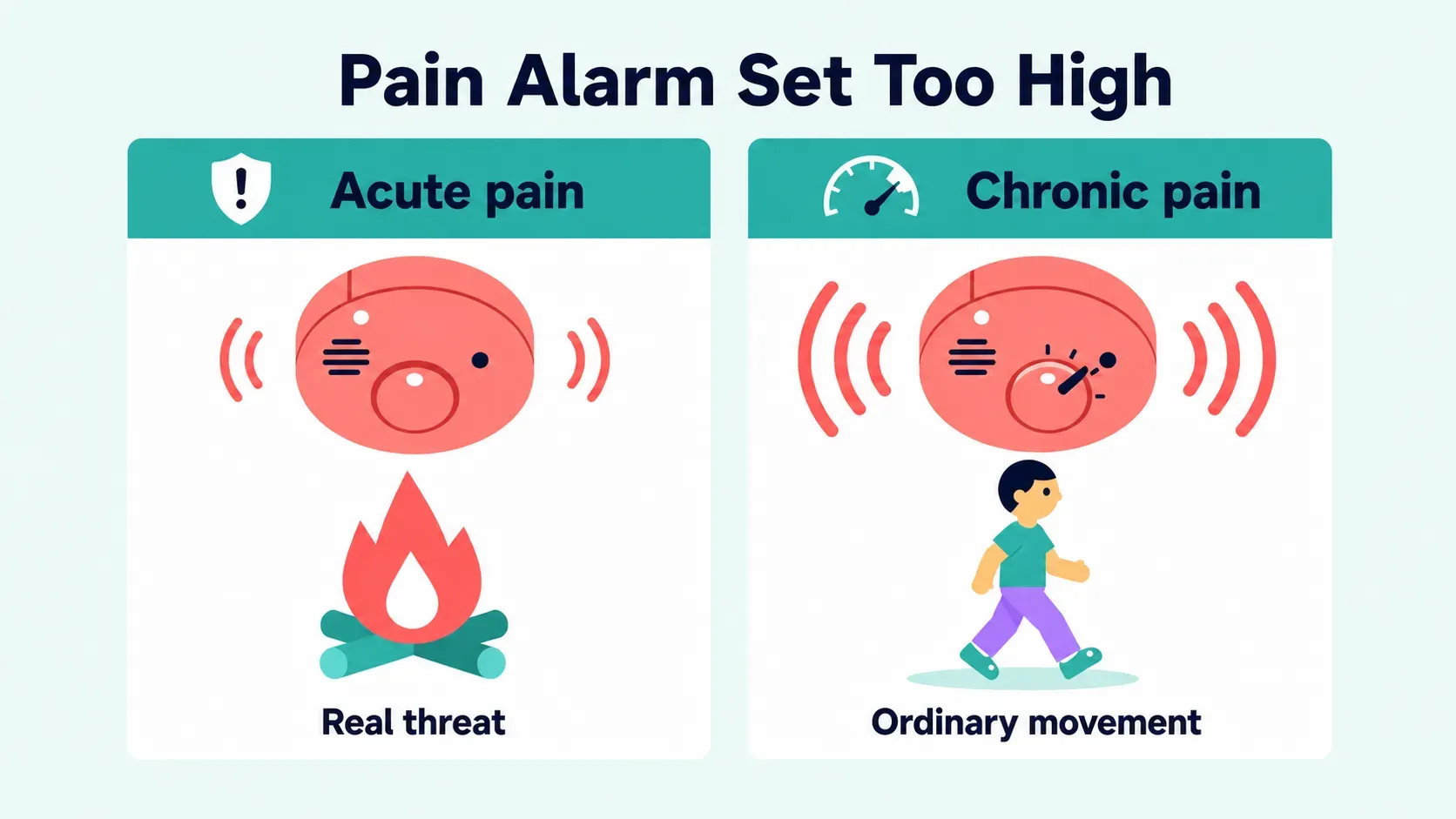
Short-term pain often warns you about injury or illness. With chronic pain, the nervous system can become more protective and sensitive than the situation requires.
Think of a smoke alarm set too high. Ordinary movement may trigger the alarm, and a mildly painful signal may feel much stronger. Pain scientists call this central sensitization. It can contribute to some chronic pain conditions, but it does not explain every person’s pain and is not a diagnosis by itself.
This pain is not imagined. Brain-imaging studies find average differences between groups with and without chronic pain, although a scan cannot show how much pain one person feels. In a 2009 Journal of Neuroscience study of 32 people with painful hip osteoarthritis, 10 were scanned again after successful hip replacement. Some gray-matter differences partly reversed after their pain resolved. This suggests pain-related brain changes can be plastic; it does not prove that every change fully “normalizes.”
How It Affects Your Daily Life
Chronic pain can drain energy, interrupt sleep, reduce concentration, and make valued activities feel threatening. Avoiding a painful activity is understandable. Over time, however, less movement can reduce strength and confidence, while fear of movement can add to disability. A gradual, individualized return to activity can help break that cycle.
Veterans carry a greater pain burden than nonveterans. In the CDC’s 2019 National Health Interview Survey, 31.5% of veterans reported chronic pain, compared with 20.1% of nonveterans. The difference was largest among adults ages 20-34: 27.1% versus 9.4%.
Pain and post-traumatic stress disorder (PTSD) also often overlap. A 2024 Military Medicine study of 5,846,453 people who used VA care in 2023 found that 53.2% of those meeting its PTSD criteria also met its chronic-pain criteria. These figures describe VA users, not every U.S. veteran. When pain and PTSD occur together, both deserve attention in the care plan.
What Physical Therapy Does
Physical therapy is one non-drug option within a broader chronic-pain plan. The CDC’s 2022 opioid guideline says nonopioid therapies are preferred for subacute and chronic pain. It lists exercise therapy for several conditions and notes that physical therapy can help some patients. The 2022 VA/DoD opioid guideline recommends against starting opioids for chronic non-cancer pain; it directs clinicians to condition-specific guidelines for nonopioid care.
The SPACE trial, published in JAMA in 2018, followed 240 VA patients with chronic back pain or hip or knee osteoarthritis pain for 12 months. Opioid medications were not better than nonopioid medications for pain-related function. The nonopioid group had slightly better pain intensity and fewer medication-related symptoms. The trial compared medication strategies, not PT with opioids, and does not tell someone already taking opioids to stop suddenly.
Evidence-based PT may include:
- Pain education plus active care. A 2024 review of 17 trials in chronic low back pain found short-term improvements when pain neuroscience education was added to exercise or physiotherapy. Long-term effects and the best format remain uncertain.
- Graded movement and exercise. Exercise can improve function and may reduce pain, but responses vary. The starting level should be tolerable and increase gradually.
- Graded exposure. If fear of a particular movement limits you, planned practice offers a structured way to approach it without asking you to ignore warning signs.
- Hands-on treatment. Manual therapy is sometimes used alongside active care. Its effects are not proof that a joint was “out of place,” and it should not be presented as a stand-alone cure.
What You Can Expect
There is no reliable universal timeline. Early goals may be better sleep, more confidence with movement, or greater ability to do what matters even before pain intensity changes. Flare-ups can happen and do not necessarily mean new damage, but new or distinctly different symptoms should be reassessed.
Progress depends on the cause and duration of pain, other conditions such as PTSD or traumatic brain injury, sleep, general health, and how well the plan matches your needs. Improvement is possible, but no treatment can promise complete pain relief.
When to Seek Help
Seek emergency care now for a new inability to urinate, loss of bladder or bowel control, numbness around the groin or buttocks, or severe or rapidly worsening leg weakness. The VA/DoD low back pain guideline treats these as warning signs of serious nerve compression.
Prompt medical assessment is also important for pain with fever or chills, unexplained weight loss, a history of cancer, a recent serious infection or surgery, major trauma, or a sudden major change from your usual pattern. These signs do not prove a dangerous cause, but they should not be managed only as a routine flare-up.
Sources
- Nociplastic pain and central sensitization: terminology update for clinicians. Brazilian Journal of Physical Therapy, 2023
- Brain gray-matter change in chronic hip osteoarthritis pain. The Journal of Neuroscience, 2009
- Chronic pain prevalence by veteran status, 2019 National Health Interview Survey. CDC MMWR, 2020
- Comorbid chronic pain and PTSD among VA users. Military Medicine, 2024
- CDC Clinical Practice Guideline for Prescribing Opioids for Pain, 2022
- VA/DoD Clinical Practice Guideline for the Use of Opioids in the Management of Chronic Pain, 2022
- SPACE randomized trial: opioid versus nonopioid medications. JAMA, 2018
- Pain neuroscience education for chronic low back pain: systematic review and meta-analysis of 17 trials. Physiotherapy Theory and Practice, 2024
- Physical activity and exercise for chronic pain: overview of Cochrane reviews, 2017
- Fear-avoidance model and chronic pain outcomes: meta-analysis. European Journal of Pain, 2022
- Manual therapy mechanisms and contextual effects. JOSPT, 2018
- VA/DoD Low Back Pain Guideline pocket card: red flags and urgent evaluation, 2022