Colombian Healthcare beyond the VA
The VA Foreign Medical Program (FMP) pays for care of your rated service-connected conditions abroad. Everything else runs through the Colombian system. This guide explains how that system works for a US veteran in Medellín, checked against official sources on August 27, 2026.
This is general educational information, not medical, insurance, immigration, tax, or legal advice. Rules, coverage, networks, and prices change. Confirm the current rule with the responsible agency and get written terms before you rely on a plan or price. For an emergency in Colombia, call 123.
The Reality
Colombia runs a mandatory national health system, the SGSSS, with two regimes: contributory for people who pay in, subsidized for people who cannot. Insurers called EPS enroll you and manage your network; hospitals and clinics called IPS deliver the care. OECD’s Health at a Glance 2025 reports that 99% of Colombians are covered for a core set of services.
Coverage on paper is not access. Waiting times, networks, and quality vary by EPS and specialty, and several large EPS are under regulatory measures. Two common mistakes: FMP is not health insurance, and EPS is not open to every foreigner. Your visa decides.
Your Visa Decides Your Coverage
- Visitor (tourist permit or V visa). EPS affiliation is built around residents with a cédula de extranjería. Plan on international health insurance plus private pay.
- Resident with work rights (M-Cónyuge, M-Compañero Permanente, work visas). Decreto 780 de 2016 makes affiliation mandatory for residents: you enroll in an EPS in the contributory regime and pay contributions set by your category. Medicina prepagada and EPS complementary plans are upgrades that require contributory affiliation first.
- M-Pensionado. This is the trap. Article 77 of Resolución 5477 de 2022 says this visa does not permit affiliation to Colombian social security unless an international agreement provides otherwise. It requires instead proof of health coverage in Colombia or a policy covering the listed risks, including illness, hospitalization, and repatriation. Confirm your case with Cancillería or an immigration lawyer before you budget for EPS.
- Permanent resident (R visa). The general rule applies: affiliation is mandatory through an EPS.
Before you choose an EPS, check the Superintendencia’s list of EPS under special measures.
What EPS Covers in 2026
Resolución 2765 de 2025 defines what the 2026 benefit plan finances. Highlights for veterans:
- Mental health. Psychology is a direct entry point; no referral needed. Outpatient psychotherapy (individual, group, family, couple) is financed, and Article 57 sets no annual cap. Access still depends on clinical indication and network availability.
- Dental. Listed procedures are financed when the main purpose is not cosmetic. Confirm the exact procedure and indication with your EPS before you count on an implant.
- Vision. Adults in the contributory regime get corrective lenses financed every 5 years; you pay for the frame. Contact lenses are not financed.
- Visit fees. Per MinSalud Circular 048 de 2025, the 2026 cuota moderadora is COP 5,000, 20,100, or 52,800 depending on income (below 2, 2 to 5, or above 5 minimum wages). A copago is a separate charge on some higher-cost services.
Most specialists require a referral (remisión) from a general practitioner. Confirm the pathway and the date with the provider.
When It Is an Emergency
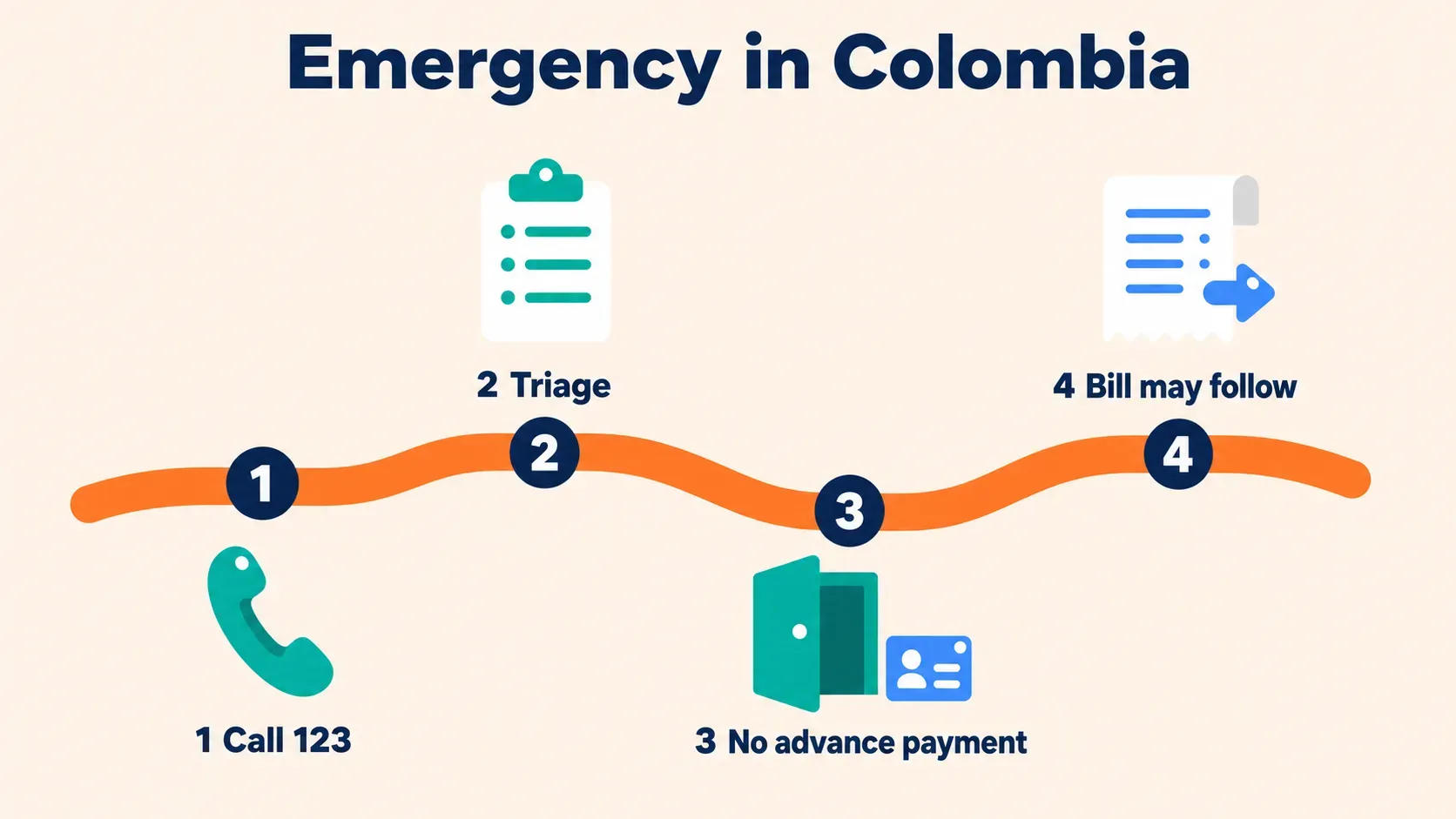
- Call 123. Medellín’s emergency system (SIES-M) routes the call and dispatches the response. Do not pick a hospital from a ranking.
- Triage decides urgency. Colombia uses 5 levels. Triage I is immediate; Triage II should be seen within 30 minutes.
- No documents, no advance payment. Ley 1751 de 2015 gives every person in Colombia the right to clinically required emergency attention without showing ID or paying first, regardless of insurance or immigration status.
- A bill may follow. Uninsured patients can be billed afterward. With EPS, Triage I to III care is exempt from the cuota moderadora; Triage IV and V may carry one. Follow the formal referral for any transfer.
Medicines, Records, and Language
Medicines. Ask your prescriber to write the generic name (principio activo). A droguería may not change the ingredient, strength, or dose. Whether a product needs a prescription depends on its INVIMA registration; get a Colombian prescription for anything you take regularly. Prices vary by product and pharmacy, so quote the exact ingredient, strength, and quantity.
Records. Ley 1581 de 2012 treats health information as sensitive data. Disclosure requires your authorization or a specific legal basis; your cédula number is an identifier, not a key to your file. Ask each provider how records and family communication work, and name in writing who you want included.
Language. Emergency rooms and EPS offices run in Spanish. A hospital that advertises an international patient program cannot guarantee a trained medical interpreter on your shift. Call ahead, and keep a backup: a bilingual friend, a phone interpreter, and your medication list in Spanish.
Tips from Experience
- Check a clinician’s license in ReTHUS, the public registry of health professionals, and a facility’s authorization in REPS.
- Get every insurance quote dated and in writing: COP amount, tax, copays, waiting periods, exclusions, network, age rules, renewal terms.
- Teletherapy from a US-licensed therapist depends on their state board, Colombia’s telemedicine rules (Resolución 2654 de 2019), malpractice coverage, and prescribing authority. Get written confirmation and a Colombian emergency plan first.
- Keep your VA benefits letter handy. FMP may cover a rated service-connected disability, a condition VA determines aggravates it, or qualifying VR&E care. Ask VA for predetermination when coverage is unclear.
- Do not let visa worries keep you from mental health care. Cancillería publishes no diagnosis-based rule.
Resources
- Emergencies in Colombia: 123
- Mental-health orientation line, free and confidential, 24 hours: 106
- Veterans Crisis Line chat, 24/7 from anywhere; the overseas calling page lists the current number.
- VA Foreign Medical Program
Sources
- MinSalud: Resolución 2765 de 2025: 2026 benefit plan: direct-entry psychology, psychotherapy (Article 57), oral health, corrective lenses (Article 54); reviewed August 27, 2026
- MinSalud: Circular 048 de 2025: 2026 cuota moderadora and copago amounts
- MinSalud: Decreto 1652 de 2022: triage levels exempt from the cuota moderadora
- Función Pública: Ley 1751 de 2015: emergency attention without documents or advance payment (Articles 10 and 14)
- Función Pública: Decreto 780 de 2016: mandatory affiliation for residents (Article 2.1.3.2)
- Cancillería: Resolución 5477 de 2022 (compiled): Article 77, M-Pensionado health coverage and social-security restriction
- MinSalud: Ley 1438 de 2011: voluntary health plans require contributory affiliation (Article 37)
- MinSalud: Decreto 2200 de 2005: prescribing by generic name and dispensing limits
- Superintendencia de Industria y Comercio: Ley 1581 de 2012: health information as sensitive personal data
- MinSalud: Resolución 2654 de 2019: telehealth and telemedicine requirements in Colombia
- Superintendencia Nacional de Salud: entities under special measures: current EPS regulatory status
- Alcaldía de Medellín: SIES-M: how 123 routes an emergency
- MinSalud: Línea 106: national mental-health orientation line
- VA: Foreign Medical Program: covered conditions and predetermination
- Veterans Crisis Line: chat and overseas calling: current channels from abroad
- OECD: Health at a Glance 2025, Colombia country profile (99% core-service coverage and resource constraints)