Culture Shock Is Real: Here's What to Expect
This post was reviewed and updated on .
Moving to Medellin means rebuilding routines, relationships, and ways of handling daily tasks. That adjustment can be stressful, but it does not unfold the same way for everyone. Veterans may also be adapting from military to civilian culture at the same time.
There Is No Standard Culture-Shock Timeline
You may have heard of four stages: honeymoon, frustration, adjustment, and mastery. They can provide useful words for an experience, but they are not a schedule.
A 2015 longitudinal study in the Journal of Personality and Social Psychology followed 2,480 teenage exchange students across more than 50 host countries. It found five different stress patterns. Most participants had only small changes in stress, and researchers found no group matching the expected honeymoon pattern. These students are not a stand-in for veterans or long-term residents, but the study offers an important lesson: there is no universal path.
You might feel excited, anxious, irritated, homesick, tired, or withdrawn. Feelings may change after a difficult errand, a good conversation, a trip home, or another major life event. Research does not support a deadline by which everyone should feel adjusted.
Why Military Transition May Add Another Layer
A 2022 Military Psychology review proposed the term reculturation for the move from military culture back into civilian culture. Military life has its own language, hierarchy, values, and social expectations. Leaving it can affect identity and belonging.
In a 2019 Pew Research Center survey, 48% of post-9/11 veterans said civilian readjustment was at least somewhat difficult. Among veterans who reported emotionally traumatic or distressing service experiences, 53% said it was difficult.
An international move may overlap with that transition: familiar systems and local support may be farther away while Spanish and Colombian norms are still new. No published study identified in this review has directly tested this combined experience among U.S. veterans abroad, so it should be understood as a reasonable possibility, not a proven outcome.
What May Make Adjustment Easier
There is no single proven formula. A 2025 Nature Communications meta-analysis covered 571,260 first-generation migrants across 1,114 studies. Feeling socially connected was among the strongest and most consistent factors associated with better psychological and day-to-day adaptation. Most evidence was observational, so it shows association, not cause.
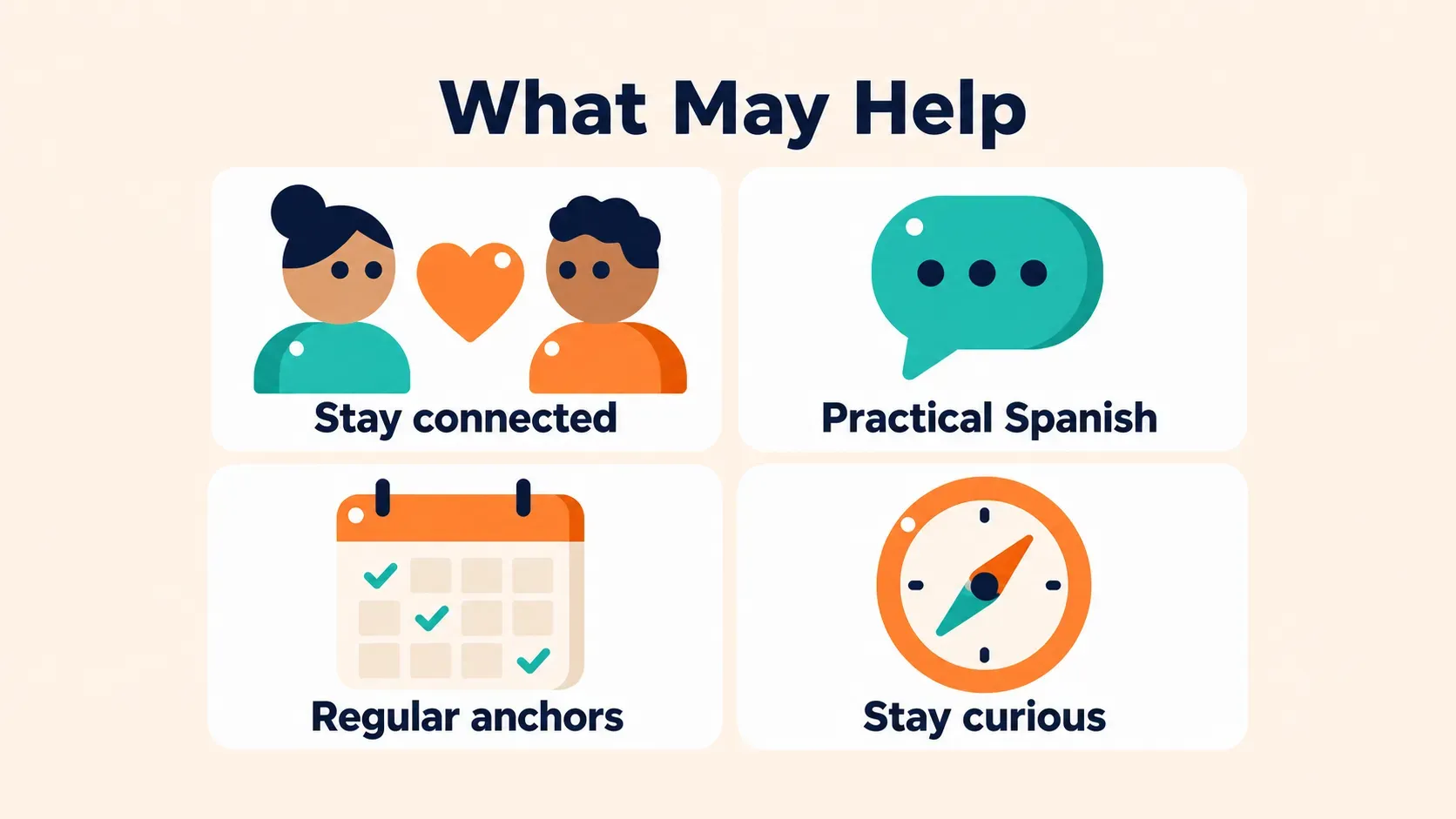
Try options that fit your health, interests, and energy:
- Strengthen useful connections. Keep in touch with people you trust and create opportunities to know people in Medellin. Support might come from family, veterans, neighbors, classmates, faith communities, or activity groups.
- Learn practical Spanish. Start with phrases needed for transportation, appointments, shopping, and brief conversations. Progress matters more than fluency.
- Create workable structure. If routine helps you, choose a few regular anchors such as meals, exercise suited to your health, a language class, or a weekly social plan.
- Stay curious without forcing assimilation. Keeping parts of your American or military identity while learning Colombian customs is a valid choice. Newer reviews find only modest and highly variable links between any one acculturation strategy and better adjustment.
When to Seek Mental Health Support
Culture-related stress is not enough to diagnose depression, PTSD, or any other condition. A clinician should consider your symptoms, health, functioning, and circumstances.
The U.S. National Institute of Mental Health says major depression involves depressed mood or loss of interest most of the time for at least two weeks, with symptoms that interfere with daily life. You do not need to wait two weeks to ask for support. Seek professional help when symptoms persist, worsen, disrupt sleep or daily responsibilities, lead to marked withdrawal or increased alcohol or drug use, or intensify an existing mental health condition.
If you have thoughts of suicide or self-harm, get immediate help:
- In the United States: Dial 988, then press 1 for the Veterans Crisis Line.
- From Colombia: Use the free, confidential Veterans Crisis Line chat, available 24/7.
- For immediate danger in Medellin: Call the city emergency number, 123.
The VA Foreign Medical Program may cover medically necessary mental health care abroad for a VA-rated service-connected disability or a condition that VA determines aggravates one. You may choose any licensed provider in the country and ordinarily do not need a referral or prior authorization, but check your FMP benefits letter or ask VA whether your care qualifies.
Sources
- The Highs and Lows of a Cultural Transition, Journal of Personality and Social Psychology, 2015: longitudinal exchange-student study
- A Meta-Analysis of Social and Contextual Correlates of Migrant Adaptation to Living in Receiving Societies, Nature Communications, 2025: large meta-analysis and limitations
- Reculturation: A New Perspective on Military-Civilian Transition Stress, Military Psychology, 2022: theoretical review
- Pew Research Center, 2019: survey on civilian readjustment
- National Institute of Mental Health: depression signs and diagnostic overview
- U.S. Department of Veterans Affairs: FMP coverage rules
- Alcaldía de Medellín: proper use of emergency line 123