Goal-Driven Chronic Pain Recovery
This post was reviewed and updated on .
Chronic pain rehabilitation is not only about lowering a pain score. It can also help you return to activities that matter to you. A specific goal, such as hiking in Colombia’s Cocora Valley, can give each part of a rehabilitation plan a purpose.
Goal-setting is useful, but it is not a shortcut or a guarantee. A Cochrane review of 39 rehabilitation studies found very-low-certainty evidence of possible benefits for self-efficacy and well-being, but no consistent improvement in physical function. The goal helps organize the work; the rehabilitation still has to fit the person.
Why a Specific Goal Can Help
Pain-related fear is associated with greater pain and disability, although research does not prove that fear alone causes either one. For some people, avoiding every activity that feels threatening can gradually reduce confidence and limit daily life.
A meaningful goal makes the plan more concrete. “Get better” is hard to measure. “Walk a chosen trail and recover normally the next day” can be divided into smaller milestones: walking time, hill tolerance, balance, strength, and recovery after activity.
Self-efficacy means confidence that you can act despite a challenge. A 2014 meta-analysis of 86 chronic pain samples found that higher self-efficacy was associated with less disability and distress and predicted better later outcomes after accounting for baseline status. That is an association, not proof that confidence by itself cures pain.
What a Cocora Valley Goal May Require
Cocora Valley routes are not one standardized hike. Distance, elevation, surface, weather, and access vary by itinerary. Colombia’s official tourism site describes ecological trails among wax palms, but it does not establish one universal route or completion time.
Depending on the route, preparation may include:
- Walking endurance for sustained time on your feet. The 2024 Adult Compendium assigns 5.3 METs to normal-paced hiking through fields and hills without a load, but actual effort changes with pace, grade, surface, load, and fitness.
- Controlled climbing and descending through leg and trunk strengthening and gradual hill practice.
- Balance and foot placement for irregular or wet ground.
- Pacing and recovery so one hard effort does not lead to several lost days.
- Practice with equipment such as shoes, a daypack, or trekking poles before the goal day.
Build toward the Goal in Stages
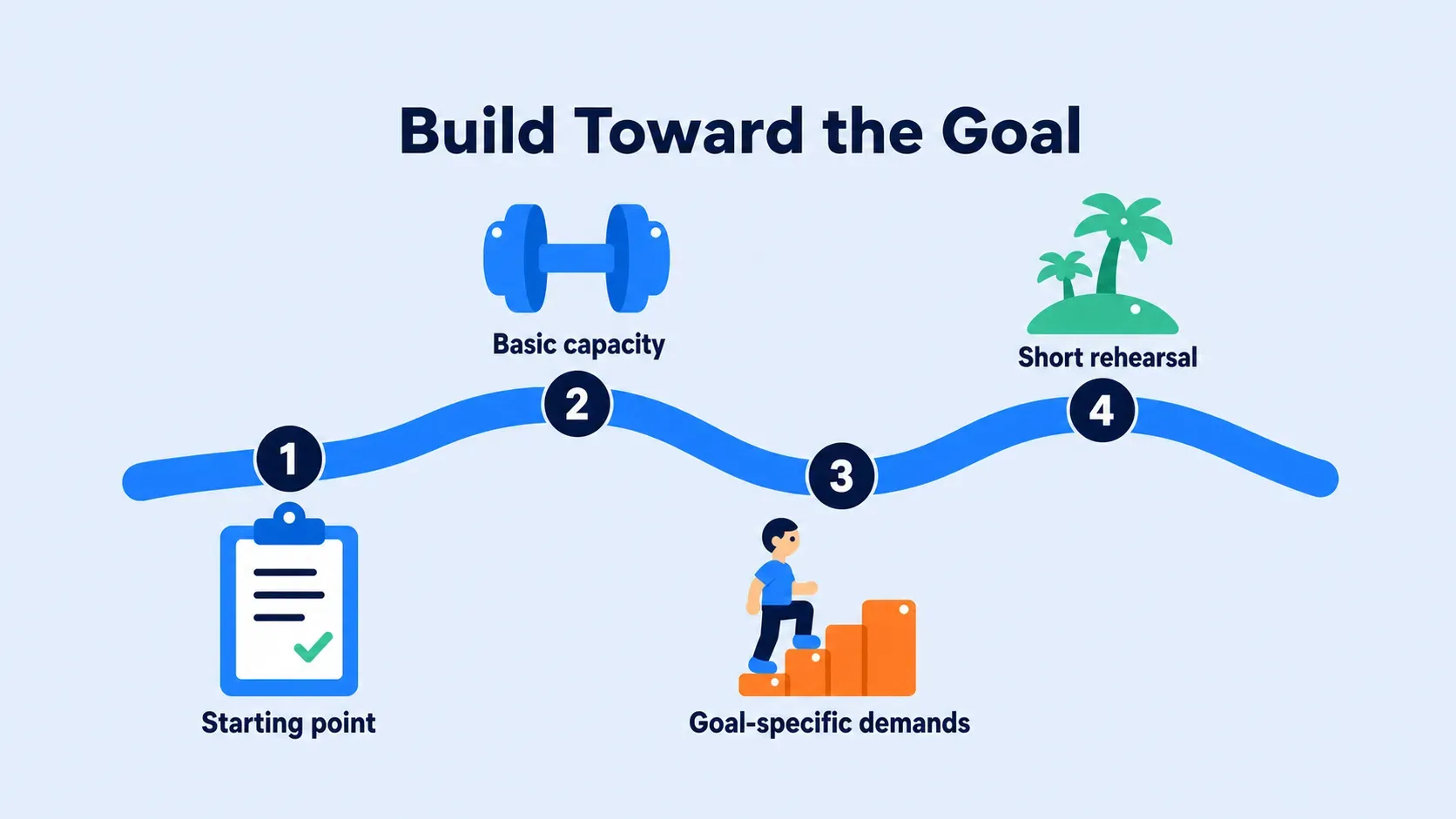
1. Establish a repeatable starting point. Record what you can do now and how you feel during the following 24 hours. Start with an amount you can repeat rather than your best recent day.
2. Build basic capacity. Use flat walking, strengthening, and balance work selected for your needs. Increase one variable at a time, such as duration, slope, surface, or carried weight.
3. Add goal-specific demands. Practice inclines, controlled descents, stairs, uneven surfaces, and any equipment you plan to use.
4. Rehearse on a shorter route. Test pacing, food, water, footwear, weather planning, and next-day recovery before attempting a longer or more remote trail.
Research supports exercise for some chronic pain conditions, but it does not provide one ideal schedule. In chronic nonspecific low back pain, a Cochrane review of 249 trials found that exercise probably improves pain compared with no treatment, usual care, or placebo; average functional improvement was small. A review of 13 trials found that graded activity produced small disability benefits over minimal care but was not clearly better than other exercise. These results do not justify a universal 8-to-12-week program or a promised three-month hiking timeline.
Use Outdoor Goals Honestly
An outdoor goal may feel more meaningful than a treadmill target. A 2025 meta-analysis of 62 studies found a small-to-moderate average reduction in self-reported pain with nature exposure, but the studies were highly varied and had moderate-to-high risk of bias. Much of the evidence involved medical procedures, experiments, or simulated nature, not outdoor chronic pain rehabilitation.
Choose an outdoor goal because it matters to you, not because nature has been proven superior treatment. Indoor training remains a valid option when weather, access, balance, or symptoms make it safer.
Common Mistakes and Course Corrections
Doing much more after one good day. Follow the planned increase. A sudden jump can make your response harder to interpret.
Treating every flare as either damage or “just pain.” A temporary increase does not automatically mean new injury, but new, severe, or persistent symptoms deserve assessment. Reduce the recent change and review the response with your clinician.
Using pain as the only measure. Also track walking time, terrain, sleep, next-day function, confidence, and recovery time.
Following someone else’s deadline. Progress depends on your condition, starting capacity, health, environment, and goal. Use milestones rather than a fixed completion date.
Safety and Altitude
A physical therapist or other qualified clinician can adapt progression to your diagnosis, medications, fall risk, heart or lung health, and previous response to exercise.
If an itinerary goes above 2,450 meters, altitude illness is possible in an unacclimatized traveler. The CDC notes that a day trip followed by return to a lower elevation is less stressful than sleeping high, but it is not risk-free. Do not ascend farther if headache develops with nausea, dizziness, or unusual fatigue after gaining elevation. Descend if symptoms worsen despite rest. Confusion, loss of coordination, or shortness of breath at rest requires urgent descent and emergency medical care.
Stop exercise and seek emergency care for chest pressure or pain, fainting, severe unexplained shortness of breath, or sudden one-sided numbness or weakness, confusion, or loss of coordination.
Sources
- Goal setting for adults receiving clinical rehabilitation for disability, Cochrane Database of Systematic Reviews, 2015
- Pain-related fear, pain intensity and function in chronic musculoskeletal pain, systematic review and meta-analysis, The Journal of Pain, 2019
- Self-efficacy and chronic pain outcomes, meta-analytic review, The Journal of Pain, 2014
- Exercise for treatment of chronic low back pain, 249-trial review, Cochrane Database of Systematic Reviews, 2021
- Graded activity and graded exposure for chronic nonspecific low back pain, systematic review and meta-analysis, Pain Medicine, 2016
- 2024 Adult Compendium of Physical Activities: walking
- Nature exposure and self-reported pain, systematic review and meta-analysis, Nature Mental Health, 2025
- Cocora Valley visitor overview, Colombia Travel
- High-altitude travel and altitude illness, CDC Yellow Book, 2026 edition
- Signs and symptoms of stroke, U.S. Centers for Disease Control and Prevention, 2024
- About heart attack, U.S. Centers for Disease Control and Prevention, 2024