How Medellin's Altitude and Climate Affect Your Body
This post was reviewed and updated on .
Medellin’s official city reference elevation is 1,479 meters, and its average temperature is about 24°C. Elevation and temperature vary across the city’s hills and neighborhoods, but one point stays practical: Medellin is not sea level, and some newcomers notice the difference during exercise.
The Altitude: A Mild Change for Most People
The American College of Cardiology defines 1,500-2,500 meters as “intermediate altitude,” where detectable physiological changes begin. Medellin is just below that range by the city’s official reference elevation. The same source says altitude illnesses tend to occur above 2,500 meters. That is reassuring, but it is not a guarantee: the CDC notes that individual susceptibility varies and illness can sometimes occur lower.
You may notice faster breathing, a higher heart rate, or earlier fatigue when climbing hills or exercising. Others notice little or nothing. Exact changes and adjustment time cannot be predicted from the limited research near Medellin’s elevation.
For your first several days:
- Start below your usual exercise intensity and increase it gradually.
- Use how you feel, not your sea-level pace, to guide effort.
- Carry water for long walks, hills, and warm days.
- Keep taking prescribed medicines unless your clinician tells you otherwise.
Do not assume severe or persistent symptoms are “just altitude.” Chest pain, fainting, confusion, breathlessness at rest, or a severe worsening headache needs prompt medical evaluation. If you have heart or lung disease, uncontrolled high blood pressure, or sleep apnea, ask your clinician how to monitor symptoms when you arrive.
What the Weather Can and Cannot Tell You about Pain
Research supports a small association between weather and pain for some people, not a promise that one climate will relieve chronic pain. A 2019 UK study in npj Digital Medicine followed 2,658 people with chronic pain. Higher humidity, stronger wind, and lower pressure were associated with more pain events, but the overall effects were modest. Temperature was not significant in that study.
That research did not study Medellin, equatorial climates, veterans, or people who relocated. We found no clinical study showing that Medellin’s weather improves chronic pain. Humidity may also bother some people. Treat the climate as something to observe, not as a treatment:
- Record pain, sleep, activity, and weather for a few weeks.
- Change one factor at a time when possible.
- Bring a clear pattern to your healthcare professional instead of changing treatment on your own.
Sun and Air Quality Deserve Daily Checks
UV exposure: Near the equator, UV protection may be needed year-round. Exact UV Index values change with cloud cover, time, and weather, so a fixed claim such as “11-14 every day” is not reliable. Check the daily UV Index. The World Health Organization recommends extra care when the index is 3 or higher: seek shade around midday, wear covering clothing, a wide-brim hat, and UV-protective sunglasses, and use broad-spectrum SPF 30+ sunscreen. Reapply it every two hours and after sweating or swimming.
Air quality: Conditions vary by station and hour in the Aburrá Valley. Readings can sometimes reach levels that call for health precautions. Check SIATA’s official PM2.5 reports before prolonged outdoor exercise. Follow the current local health guidance rather than relying on a fixed month or color. If you have asthma, COPD, or another heart or lung condition, reduce or move outdoor exertion indoors when official readings are unhealthy for your group.
A Practical First-Week Plan
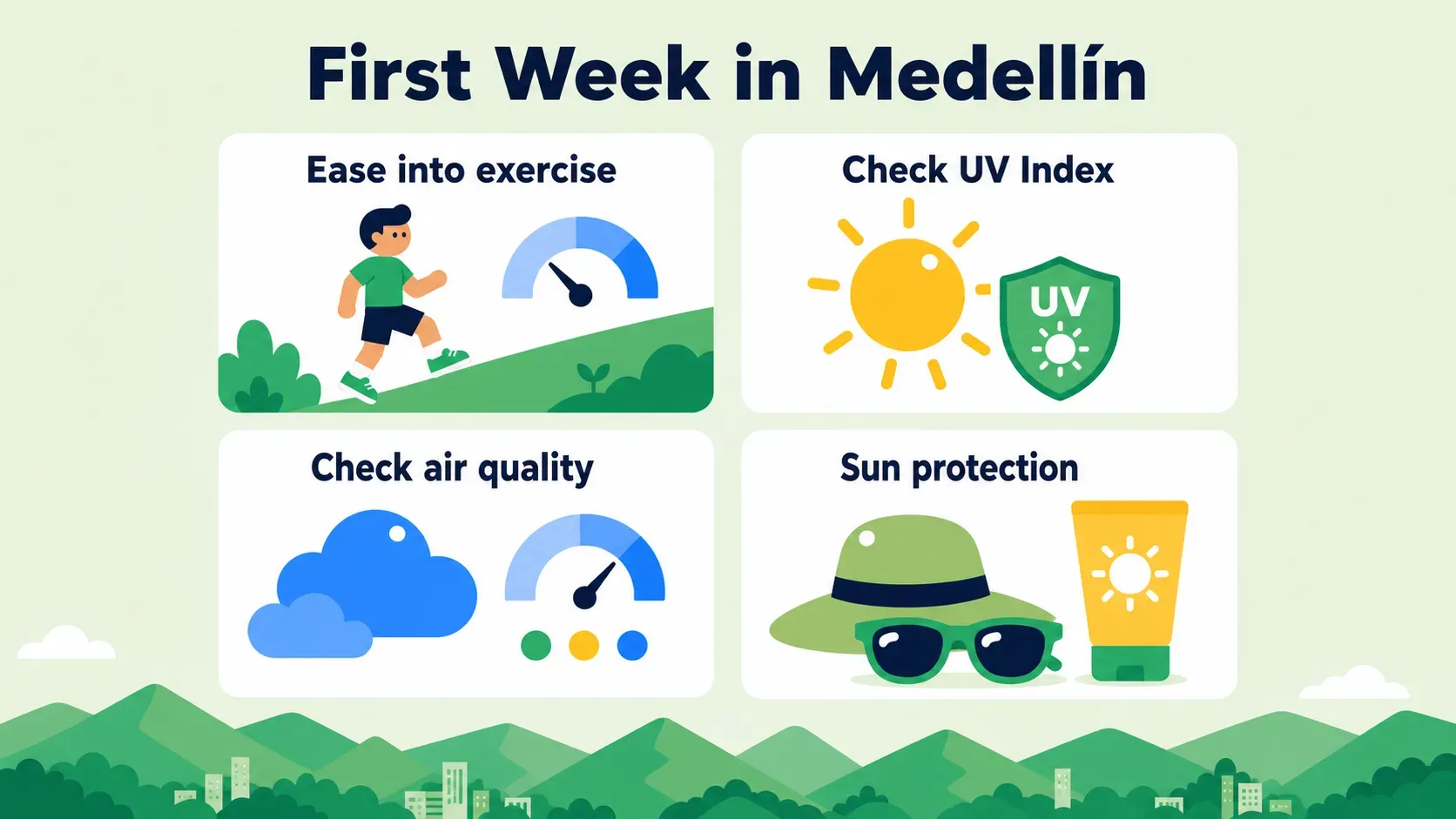
- Keep exercise easier, then build up according to symptoms.
- Check UV and air quality before a long outdoor session.
- Use sun protection even when the air feels cool.
- Track blood pressure if your clinician has already asked you to monitor it.
- Get medical advice for symptoms that are severe, unusual, or not improving.
Sources
- City of Medellin: general city data (official reference elevation and average temperature).
- American College of Cardiology: “Exercise and Elevation” (2021) and the CDC Yellow Book: “High-Altitude Travel and Altitude Illness” (altitude classification, exercise physiology, and current illness guidance).
- Dixon et al., “How the weather affects the pain of citizen scientists using a smartphone app”, npj Digital Medicine (2019).
- World Health Organization: “Protecting against skin cancer” (UV Index and sun-protection guidance).
- SIATA: official PM2.5 reports (Valle de Aburrá air-quality monitoring).