How Stress Turns Up the Volume on Pain
This post was reviewed and updated on .
Your pain is real. Stress can change how strongly you experience pain, but that does not mean the pain is imagined or that stress is its only cause.
Why Stress Can Turn Up the Volume
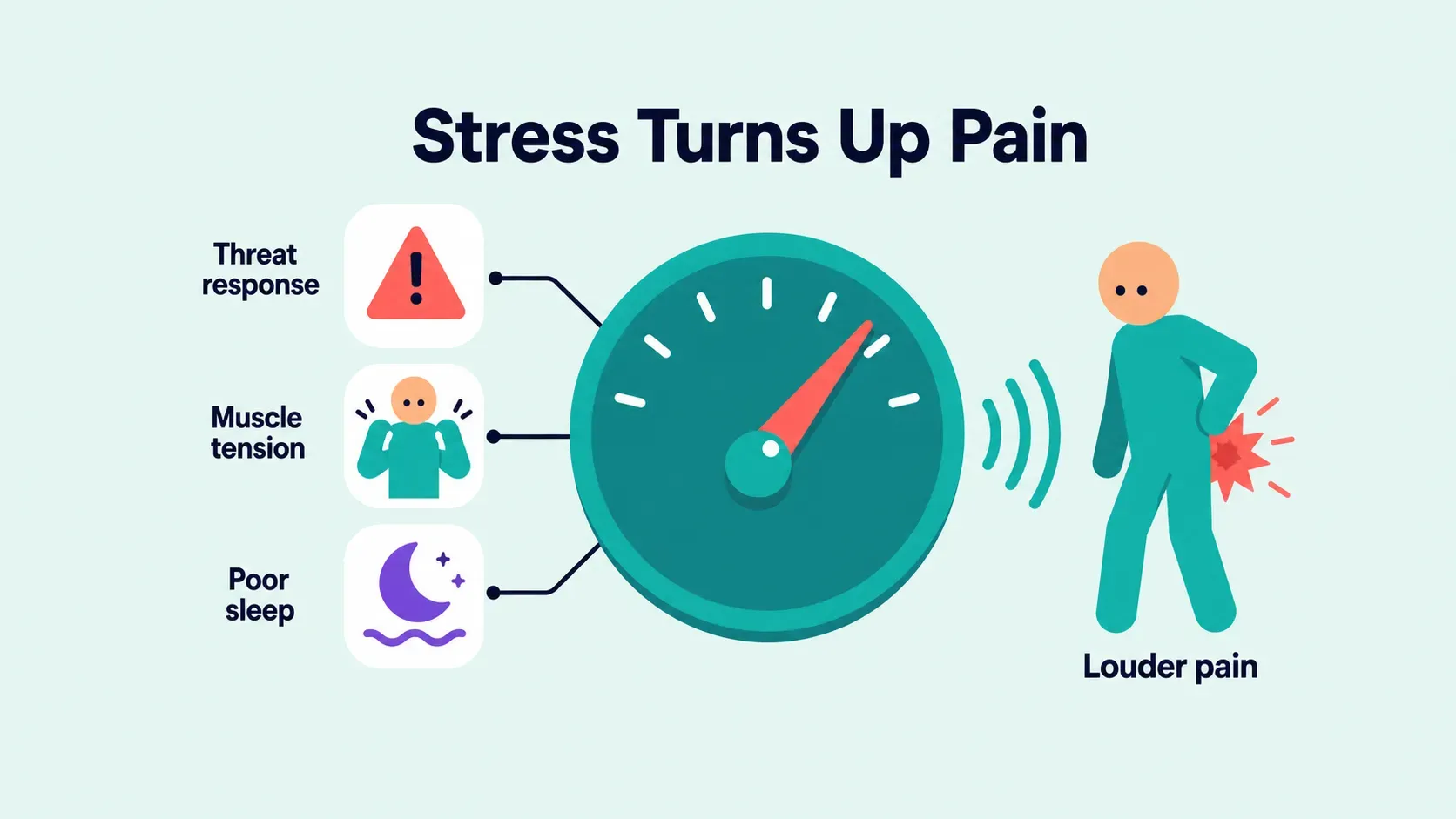
Pain is not a simple readout of tissue damage. Your brain and nervous system process information from your body alongside sleep, attention, past experiences, mood, and whether you feel safe or under threat. Persistent stress can keep the body’s threat response active, increase muscle tension, disrupt sleep, and make pain harder to manage. Pain can also create stress, so the relationship runs both ways.
The biology is more complicated than a single cortisol pathway. Studies have found both lower and higher cortisol patterns in different chronic pain groups. It is therefore inaccurate to say that everyone’s cortisol receptors “shut down” or that chronic pain causes universal “cortisol depletion.”
Brain-imaging studies also show associations among chronic pain, stress hormones, and areas involved in memory and emotion. These studies do not prove that stress caused brain shrinkage. They support a more careful conclusion: stress and pain share biological systems that can influence each other.
Why This Matters for Veterans
A 2024 study using 2023 VA records included 5,846,453 VA service users. It found that 35.8% met the study’s criteria for chronic pain and 14.5% for post-traumatic stress disorder (PTSD). Among those who met the PTSD criteria, 53.2% also met the chronic-pain criteria. These figures describe VA service users in that year, not every U.S. veteran.
PTSD does not produce one universal pain response. A systematic review of 21 laboratory studies found that pain thresholds differed by trauma type and that results varied across people. This is more accurate than describing PTSD pain processing as a single “all-or-nothing” pattern.
Sleep deserves attention too. In a randomized trial of 85 Gulf War veterans who had Gulf War Illness and insomnia, eight weeks of telephone-based cognitive behavioral therapy for insomnia reduced pain interference compared with a wait-list group. It did not significantly reduce pain severity. Better sleep can help pain affect daily life less, but it is not a guaranteed pain cure.
What Physical Therapy Can Do
Physical therapy can address parts of the stress-pain cycle without treating PTSD itself. Care may include:
- Pain education plus movement. A 2024 review of 17 randomized trials involving 1,078 people with chronic low back pain found that pain neuroscience education combined with exercise or physical therapy improved short-term pain and disability more than exercise or physical therapy alone. This evidence is specific to chronic low back pain and does not guarantee the same result for every condition.
- Graded activity. A PT can help you choose a safe starting point, pace activity, and increase it according to your response and goals. The aim is better function and confidence, not forcing movement through every symptom.
- Breathing or relaxation practice. Slow, paced breathing may reduce pain for some people. A systematic review found mixed results and said the mechanism remains uncertain. It should not be presented as proven to “stimulate the vagus nerve,” lower inflammation, or work best at one exact breathing rate for every person.
- Coordinated care. Some VA facilities offer Active Management of Pain programs that combine physical therapy with behavioral pain strategies. A PT should refer to qualified mental health care when PTSD symptoms, dissociation, or severe distress need treatment.
What You Can Expect
There is no evidence-based promise that most people improve within a set number of weeks. Progress depends on the pain condition, sleep, health, treatment plan, and what matters to you. Useful changes may include doing more, sleeping better, feeling less afraid of movement, or having pain interfere less with daily life.
Flare-ups can happen and do not automatically mean a new injury. However, new or rapidly worsening symptoms need medical assessment. If breathing or body-awareness exercises trigger flashbacks, dissociation, panic, or distress, stop and tell your clinician. The approach can be changed or replaced.
When to Seek Help
Contact a healthcare professional promptly if your pain changes substantially, new numbness or weakness appears, or symptoms keep worsening.
Go to the nearest emergency department immediately for new loss of bladder or bowel control, inability to urinate, numbness around the groin or “saddle” area, or rapidly worsening leg weakness. These can be warning signs of cauda equina syndrome, a medical emergency.
For a mental health crisis in Medellín, call 123. Veterans in Colombia can also use the Veterans Crisis Line’s confidential online chat or call the SOUTHCOM overseas number, +1 866-989-9599. The U.S. numbers 988 and 838255 may not work with a Colombian phone provider; international call charges may apply.
Sources
- Hadlandsmyth et al. Comorbid chronic pain and PTSD among 5,846,453 VA service users in 2023. Military Medicine, 2024. https://pmc.ncbi.nlm.nih.gov/articles/PMC11536323/
- Pain perception and processing in people with PTSD: systematic review and meta-analysis of 21 studies. PAIN, 2021. https://pubmed.ncbi.nlm.nih.gov/33490843/
- Cognitive behavioral therapy for insomnia in 85 veterans with Gulf War Illness: randomized trial. Life Sciences, 2021. https://pmc.ncbi.nlm.nih.gov/articles/PMC8217272/
- HPA-axis function and chronic widespread pain. Arthritis Research & Therapy, 2005. https://pubmed.ncbi.nlm.nih.gov/16207340/
- Basal cortisol and hippocampal structure in chronic back pain. Brain, 2013. https://pubmed.ncbi.nlm.nih.gov/23436504/
- Pain neuroscience education for chronic low back pain: review of 17 randomized trials. Physiotherapy Theory and Practice, 2024. https://pubmed.ncbi.nlm.nih.gov/37395152/
- Pain and respiration: systematic review. Pain, 2017. https://pubmed.ncbi.nlm.nih.gov/28240995/
- VA Cognitive Behavioral Therapy for Chronic Pain program. https://www.va.gov/PAINMANAGEMENT/CBT_CP/index.asp
- VA Active Management of Pain program description. https://www.va.gov/columbia-south-carolina-health-care/stories/active-management-of-pain-program-helps-veterans-take-control-of-chronic-pain/
- American Association of Neurological Surgeons: cauda equina syndrome warning signs. https://www.aans.org/patients/conditions-treatments/cauda-equina-syndrome/
- Veterans Crisis Line: overseas calling and chat information. https://www.veteranscrisisline.net/get-help-now/military-crisis-line/
- Medellín Secretary of Health: mental health crisis services and 123. https://www.medellin.gov.co/es/secretaria-de-salud/salud-mental/